
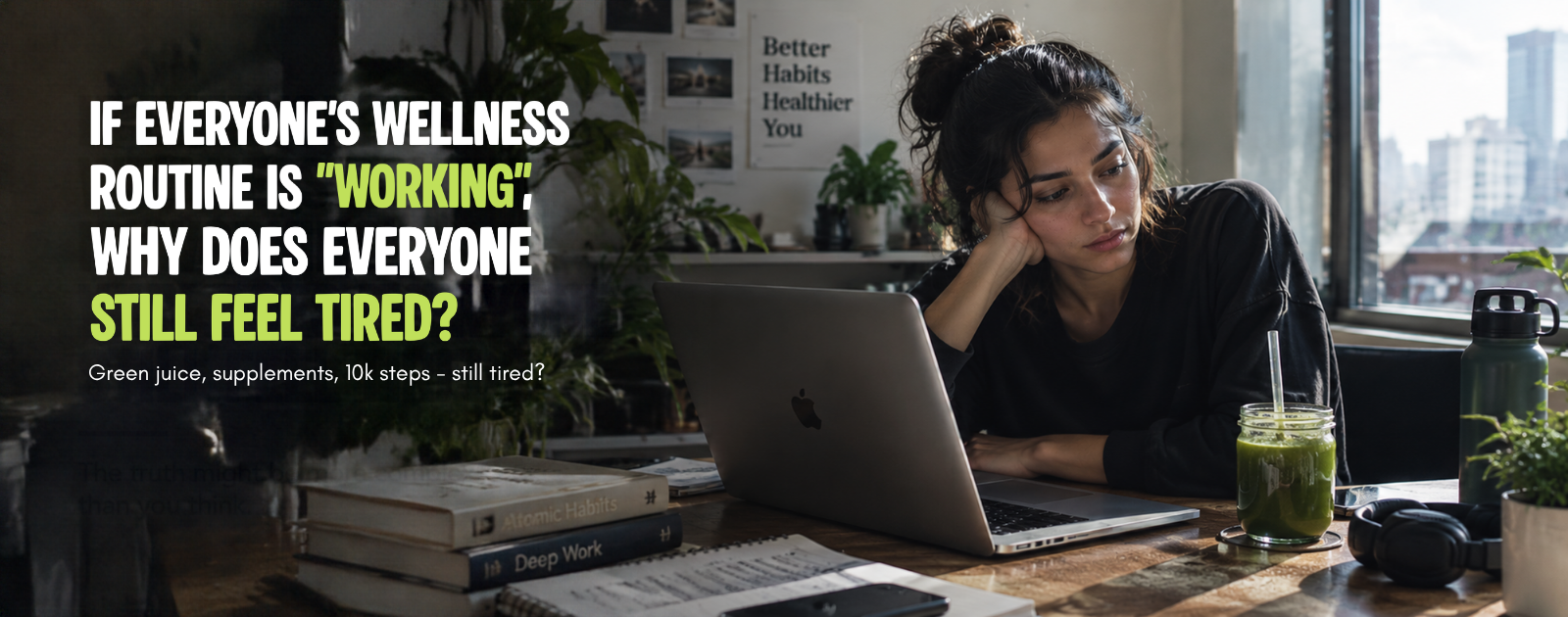
Walk into most people’s daily routine today and it looks impressive on paper – a 6 am alarm, a workout, a green smoothie, a supplement snack, 10,000 steps. By every visible measure, it’s “working.” And yet, ask, the same person how they feel by 3 PM, and the answer is often: exhausted.
The gap between “doing the right things” and “feeling right” isn’t just a mindset problem-there are real, measurable mechanisms behind it. Let’s go through them one at a time.
Most people track how long they sleep and assume that settles the question. But research specifically isolating sleep fragmentation – waking briefly, even without remembering it – has found it can impair next-day cognitive function and increase subjective fatigue even when total sleep time stays exact same exactly the same. One controlled study published in the International Journal of Environmental Research and Public Health head participants sleep the same number of hours across different nights, but disrupted some nights with brief, non-waking sound simulations. Fatigue still increased and sleep architecture still broke down – despite identical time in bed. The impact of sleep fragmentation on daytime cognitive function is an area of established research, with prior work showing that sleep deprivation or impaired sleep quality can negatively affect both physical health and cognitive performance.
In plain terms: your tracker can say “8 hours” and still be technically wrong about how rested you actually are.
Cortisol – your primary stress hormone – is regulated by a system called the HPA axis (hypothalamus-pituitary-adrenal axis). Under normal conditions, this system ramps up in short bursts of stress and then settles back down. But chronic stress exposure has been shown to alter how this system functions, which researchers believe may plan may play a role in negative outcomes like persistent fatigue and low mood.
This matters because a single hard workout or a clean diet doesn’t reset this system – It responds to sustained patterns, not isolated healthy choices. If your day is otherwise full of low-grade stress (notifications, deadlines, constant decision-making), your body can stay in a mild “alert” state regardless of how disciplined your routine looks.
The idea that willpower and decision making draw from a limited daily resource is known as ego depletion or decision fatigue a concept introduced by psychologist Roy Call MR after experiments showing that people who observed self control on one task performed worse on a subsequent task requiring self control, compared to people who didn’t have to resist temptation first.
In fairness, it’s worth being transparent here: large-scale attempts to replicate the original ego-depletion effect across many research labs have failed to reproduce it consistently, and many researchers now treat the underlying theory as unproven rather than settled science. What isn’t in dispute is the everyday experience it describes – tracking macros, reading every label, and making constant “correct choice” decisions all day is mentally effortful, whether or not it drains a literal reservoir. Either way, a routine built entirely around vigilance can end up costing the same energy it’s meant to protect.
This is where the science is most direct. Several nutrients have well-documented, mechanistic links to fatigue when they run low:
The catch: these gaps can exist inside diets that otherwise look “clean” – especially when meals are repetitive, rushed, or overly restrictive.
Scrolling on the couch keeps your brain in a state of low-grade stimulation and alertness, rather than shifting your body into the parasympathetic (“rest and digest”) state associated with actual recovery. This is a basic distinction in how the nervous system works – active input (even passive-feeling scrolling) is processed differently than genuine downtime, this is one reason “relaxing” on a screen for an hour often doesn’t leave you feeling as recovered as time spent doing nothing at all.
Yes – and it’s backed by research. Sleep fragmentation, chronic cortisol elevation, and common micronutrient gaps can all produce fatigue independently of diet quality or exercise consistency.
It’s worth ruling out. Persistent fatigue can be linked to thyroid issues, anemia, vitamin D or B-12 deficiency, or other medical causes. A simple blood panel can check for the most common ones-worth doing before assuming it’s “just lifestyle.”
Iron deficiency is considered the most common nutritional cause of fatigue globally, followed by vitamin D and B-12 – all three are inexpensive to test for.
This article is for general information and isn’t a substitute for medical advice. If fatigue is persistent, unexplained, or paired with other symptoms, it’s worth speaking with a doctor – a basic blood panel can rule out the most common nutritional and thyroid related causes.
Maybe that’s the real shift worth making – not one more habit stacked onto an already full routine, but attention to the handful of things that actually have evidence behind them: sleep continuity, stress load, and a small set of nutrients most diets quietly undeliver on.
