
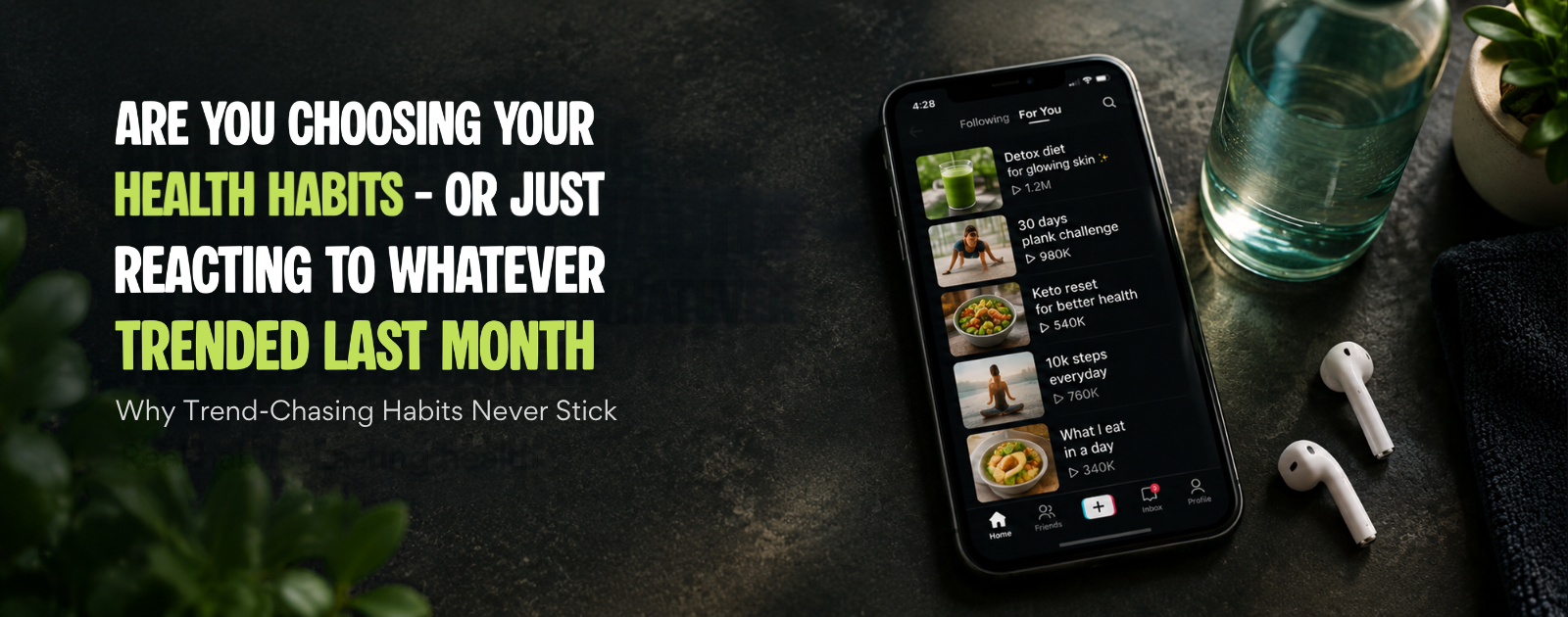
There’s a well-documented psychological mechanism behind this, called the bandwagon effect (or social proof). It’s the tendency to adopt a behavior simply because a growing number of other people appear to be doing it – largely because, in situations of uncertainty, we use other people’s actions as a shortcut for “what’s probably correct.” The more a trend appears to be adopted, the stronger the pull to join it, creating a snowball effect that has little to do with whether the trend actually works.
Social media accelerates this considerably. Constant exposure to a trend – a supplement, a morning routine, a way of eating – makes it feel more common and more validated than it may actually be, a bias researchers call the availability heuristic: we tend to overestimate how important or effective something is simply because we keep seeing it. Add a dose of FOMO, and it’s easy to see why switching to whatever’s trending feels like the rational choice in the moment, even when it isn’t.
None of this makes trend-following irrational as a psychological response – it’s a completely normal shortcut. The problem is what it does to actually habit formation underneath.
The most-cited research on this comes from a 2010 study by health psychologist Phillippa Lally and colleagues at University College London, published in the European Journal of Social Psychology. Participants picked a simple daily health behavior – drinking water at lunch, eating fruit with dinner – and were tracked for 12 weeks to see how long it took for the behavior to become automatic (performed without conscious effort).
The results: it took an average of 66 days for a habit to become automatic. But that average heights a wide range – some people got there in 18 days, other took as long as 254 days, depending on the complexity of the habit and the person. Exercise-related habits, notably, tended to take longer than simple dietary ones.
Two findings from the research matter specifically for trend – chasing:
• Missing a single day barely affects habit formation — the study found it caused only a very small dip in “automaticity,” with no lasting damage. Consistency, not perfection, is what drives the process.
• Switching the behavior essentially restarts the clock. Automaticity is built around one specific, repeated action. When you swap that action for a new “better” one – a new supplement, a new morning ritual, a new diet – you’re not extending progress. You’re starting the 66-day (or longer) process over again from zero.
This is the mechanical reason trend-hopping rarely produces lasting results: It isn’t that trends are always bad, it’s that switching too early never lets any single habit reach the point where it runs on autopilot.
This isn’t just theoretical. Consumer research tracking dieters consistently finds a similar pattern: a large share of people abandoned a new diet within the first week, and only a small fraction are still following it a year later – commonly cited figures put long-term adherence at around 1 in 20 dieters after 12 months. Surveyed dieters most often cite the plan being too restrictive or simply “tiring of it” as their reason for quitting – not that it failed to work in principle, but that it was never designed to be lived with.
The pattern lines up with the habit-formation research above: most trending health regimes are, by design, short bursts of novelty. They’re built to be tried, not built to become automatic.
• Pick one thing and give it the full runway. Based on the UCL research, that means committing to a single habit for at least 8-10 weeks before judging whether it’s “working.” It doesn’t need to be dramatic – something as simple as swapping your evening snack for a roasted edamame bowl and sticking with just that, without adding five other “optimizations” on top, is exactly the kind of single, repeatable action that has a real shot at becoming automatic.
• Let a missed day be just a missed day. The data shows one lapse causes minimal damage – the real habit-killer is switching to something new entirely, not an imperfect week.
• Ask what a trend is replacing, not just what it promises. If adopting the newest thing means abandoning a habit that was 40 days into becoming automatic, the trade is rarely worth it.
• Notice the pull itself. If the urge to switch is coming from “everyone’s doing this now” rather than a real problem with what you’re currently doing, that’s the bandwagon effect talking – not evidence.
No inherently – trying things is how you find what fits. The issue is switching before giving a habit enough time to become automatic, which research suggests take an average of 66 days, sometimes considerably longer.
That’s largely the novelty and social-proof effect driving initial enthusiasm – it’s a real psychological pull, but it isn’t the same mechanism that sustains a habit long-term. long-term adherence depends on repetition and automaticity, not initial motivation.
A useful test: would you keep doing it if no one else around you were doing it, and if it stopped being talked about online? If the honest answer is no, it’s likely trend-driven rather than a genuine, chosen habit – a routine built around small, repeatable choices, not the next thing trending.
The article is for general information and isn’t a substitute for personalized nutrition or medical advice.
Maybe the real skill in wellness isn’t finding the next right thing – it’s staying with the last right thing long enough for it to stop feeling like effort at all.
